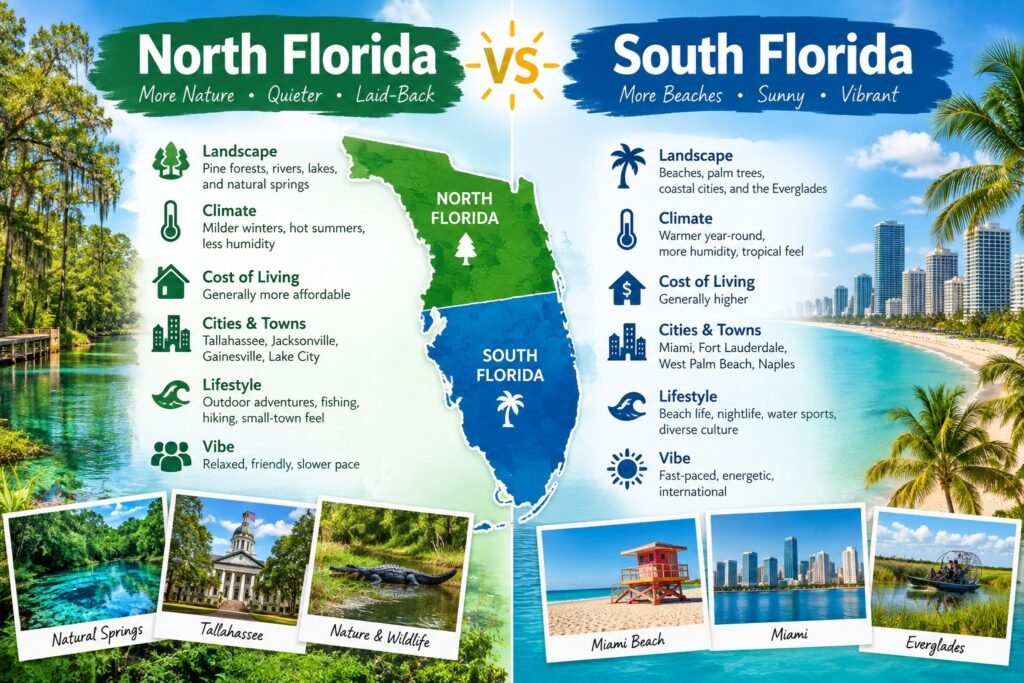
Comparing North vs South Florida involves much more than choosing between two parts of the same state. The regions differ in climate, development, housing, transportation, employment and culture. A person who enjoys life in Jacksonville or Tallahassee may not have the same experience in Miami or Fort Lauderdale.
There is no official line separating North Florida from South Florida. Central Florida also forms its own distinctive region around Orlando, Tampa Bay and the communities between the two coasts. Still, comparing the northern and southern parts of the state can help new residents narrow their search.
If you are choosing a community remotely, begin with this guide after reviewing the essential research involved in moving to Florida without visiting first.
What Is Considered North Florida?
North Florida generally includes the Panhandle, Tallahassee, Jacksonville, Gainesville and surrounding inland and coastal communities. Depending on the context, people may also include parts of Northeast Florida and North Central Florida.
The region contains major cities, college towns, military communities, beach destinations and large rural areas. Development is often less continuous than it is in South Florida. You may travel through forests, farmland and small towns between the principal population centres.
North Florida’s proximity to Georgia and Alabama also influences its culture, food and regional identity. Some communities feel more similar to other parts of the Southeast than to Miami or the Florida Keys.
What Is Considered South Florida?
South Florida generally refers to Miami-Dade, Broward and Palm Beach counties. Broader definitions may include the Florida Keys and parts of Southwest Florida, although residents do not always agree about the boundaries.
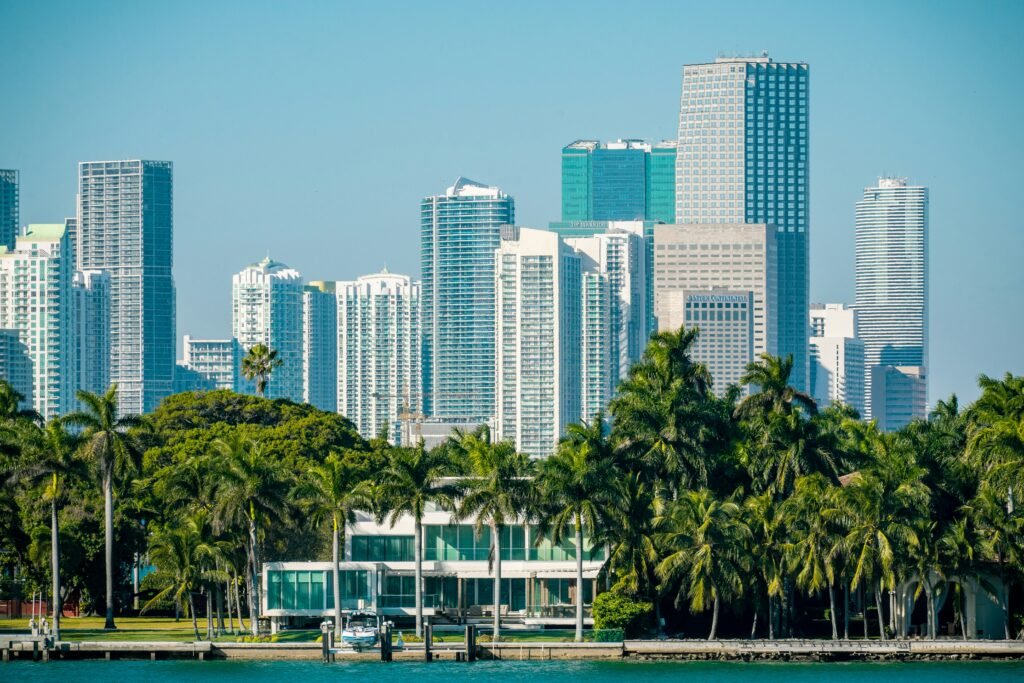
The Miami–Fort Lauderdale–West Palm Beach area forms a long, densely developed metropolitan corridor along the Atlantic Coast. The region is internationally connected and includes communities shaped by Caribbean, Latin American and other global cultures.
South Florida also has significant differences within the region. Life in central Miami can be very different from life in a western Broward suburb, a Palm Beach County retirement community or a town in the Florida Keys.
Climate and Seasonal Changes
Both regions experience hot, humid summers, frequent thunderstorms and hurricane risk. However, winters are noticeably different.
North Florida usually experiences cooler winter temperatures. Cold fronts can bring frosty mornings, and freezing conditions are possible in some inland locations. Residents may use both heating and air conditioning during the year.
South Florida generally has warmer winters and a more tropical climate. Cold weather is less common, although occasional cold fronts can still feel uncomfortable in homes designed primarily for cooling. The warmer winter season is one of the region’s strongest attractions.
Summer can feel long in both regions. South Florida often remains warm and humid later into the year, while North Florida may receive more noticeable seasonal changes. Someone moving from a colder state should not assume that North Florida is warm every day simply because it is in Florida.
Climate can also affect landscaping. Tropical plants that grow easily in South Florida may require protection or may not survive winter conditions farther north.
Housing and Property Types
Housing costs vary by city, neighborhood and distance from the coast. However, South Florida’s major metropolitan areas generally place greater pressure on renters and buyers, particularly near employment centres and desirable coastal communities.
Condominiums, apartments and closely spaced suburban developments are common across South Florida. Some buildings and communities charge association fees that can significantly increase monthly housing expenses.
North Florida offers a wider selection of lower-density communities, rural properties and homes with larger lots. That does not mean every northern city is inexpensive. Popular neighborhoods in Jacksonville, Gainesville and other growing areas can still be competitive.
Construction styles may differ as well. South Florida has many concrete block homes, high-rise condominiums and properties designed with tropical conditions in mind. North Florida has a greater mixture of block, brick and wood-frame construction.
Before buying, compare the complete cost of ownership rather than the listing price alone. Insurance, property taxes, association fees, flood coverage, maintenance and commuting expenses can change which home is genuinely affordable.
Florida homeowners who establish a permanent residence may qualify for property tax benefits. The Florida Department of Revenue explains the state’s homestead exemption and related assessment limitations. Eligibility and individual tax consequences should be confirmed with the relevant county property appraiser.
Home Insurance and Storm Exposure
Hurricanes can affect any part of Florida. North Florida is not automatically protected because it sits farther from the tropics, and South Florida is not the only region exposed to damaging wind or flooding.
Risk depends on the individual property. Coastal position, elevation, roof condition, construction type, nearby waterways and evacuation access may matter more than whether the address is in the northern or southern part of the state.
South Florida residents may face higher insurance costs in some coastal areas because of property values and storm exposure. North Florida homeowners can also encounter expensive coverage, especially near the Gulf or Atlantic coast.
Obtain estimates for the exact property before signing a purchase agreement. Find out whether separate flood insurance may be appropriate and how the hurricane deductible works.
Evacuation and Flooding
Both North and South Florida contain coastal, riverfront and low-lying communities. Flooding can also occur away from the coast when heavy rain overwhelms drainage systems.
South Florida’s dense population can make hurricane evacuation challenging. Major roads may become congested, and travelling north does not always provide the safest or most practical plan.
North Florida includes less densely developed areas, but some coastal and rural communities have limited evacuation routes. Roads may cross bridges, rivers or low-lying land that becomes difficult to use during severe weather.
Check each prospective address using Florida’s official evacuation zone tool. An evacuation zone should not be confused with a FEMA flood zone. Residents need to understand both forms of risk and follow local instructions when an emergency develops.
Traffic and Transportation
South Florida has extensive highways, toll roads, commuter rail services and local transit systems. However, congestion can make relatively short journeys unpredictable, particularly during morning and evening travel periods.
Some South Florida residents can live near rail or bus routes, but many still depend on cars. Parking charges, tolls and automobile insurance can add substantially to the cost of commuting.
North Florida generally has fewer continuous urban transit options. Jacksonville covers a large geographic area, and residents may need to drive considerable distances between home, work and essential services.
Traffic may be lighter outside the main cities, but rural living creates a different transportation challenge. Grocery stores, hospitals and workplaces can be far apart. A lower housing payment may be offset by fuel costs and additional driving.
Test prospective commutes at the times you would normally travel. A map showing distance cannot account for bridge traffic, toll plazas, school congestion, tourism or limited alternative routes.
Employment and Income
South Florida has large employment markets connected to healthcare, finance, international trade, hospitality, real estate, aviation and professional services. Knowledge of Spanish or another language can be valuable or necessary in certain workplaces and customer-facing roles.
North Florida has employment connected to state government, universities, healthcare, logistics, military installations, financial services and manufacturing. Tallahassee is strongly influenced by state government and higher education, while Jacksonville has a large logistics, healthcare and financial-services presence.
Available wages should be compared with local housing and transportation expenses. A higher salary in South Florida may not provide greater disposable income if rent, insurance and commuting costs are considerably higher.
Remote workers should confirm internet service at the exact address. This is especially important in rural parts of North Florida, where service availability can vary from one road to another.
Beaches and Outdoor Recreation
South Florida is known for warm Atlantic beaches, boating, diving and access to the Everglades and Florida Keys. Popular coastal locations can become crowded, and parking may be expensive or difficult to find.
North Florida offers Atlantic and Gulf beaches, natural springs, rivers, forests and state parks. Some coastal areas feel quieter and less intensely developed, although popular destinations can still attract seasonal crowds.
The water may feel cooler in North Florida during winter. Seasonal weather can also have a greater effect on outdoor plans. South Florida generally offers warmer winter beach conditions, but summer heat and humidity can limit comfortable daytime activity.
Beach quality, water conditions, parking rules and public access differ by community. Living near the coast does not always mean you will have convenient access to a quiet or free beach.
Culture and Community Life
South Florida is culturally and linguistically diverse. Its food, festivals, businesses and social life reflect strong connections to Latin America, the Caribbean and international migration. The pace of life can feel energetic and metropolitan.
North Florida often has a more traditional Southern influence, especially in smaller communities and rural areas. College towns and Jacksonville provide more varied cultural environments, but the overall pace may feel slower outside the major cities.
Political attitudes, religious participation and community expectations can also differ by county and neighborhood. Statewide labels rarely describe every community accurately.
Spend time researching individual cities rather than assuming that all northern or southern residents share the same lifestyle.
Access to Healthcare and Essential Services
South Florida has extensive hospital networks, specialists and medical facilities, although traffic can make appointments difficult to reach. Availability may also depend on insurance networks and whether a practice is accepting new patients.
North Florida’s major cities have substantial healthcare systems, but residents of smaller towns may travel farther for specialists or advanced care. This can be an important consideration for retirees, people managing chronic conditions and families with children.
Check the distance to hospitals, urgent care centres, pharmacies and preferred specialists before choosing a home. A quiet rural property may become less practical if frequent medical travel is required.
Choosing Between North and South Florida
North Florida may suit people who prefer cooler winters, lower-density development, larger properties or easier access to rural recreation. It can also work well for residents connected to universities, state government, military installations or Jacksonville-area employment.
South Florida may appeal to people seeking warmer winters, international culture, a larger metropolitan employment market and access to tropical beaches. They should be prepared to investigate housing, traffic, insurance and storm evacuation carefully.
Neither region is universally better or more affordable. The right choice depends on the exact city, neighborhood, property and daily routine. Compare the following before making a decision:
- Total housing and insurance costs
- Distance from work and essential services
- Flood and evacuation conditions
- Transportation and toll expenses
- Climate and preferred outdoor activities
- Access to healthcare, schools and community resources
A realistic comparison should focus on ordinary weekdays rather than vacation experiences. Beaches and winter weather may attract someone to Florida, but housing expenses, commutes, medical access and summer conditions will have a greater influence on long-term satisfaction.
Note: Regional boundaries are informal, and conditions vary significantly between Florida counties and communities. Confirm housing expenses, insurance availability, flood risk, evacuation information and local services for the specific address you are considering.