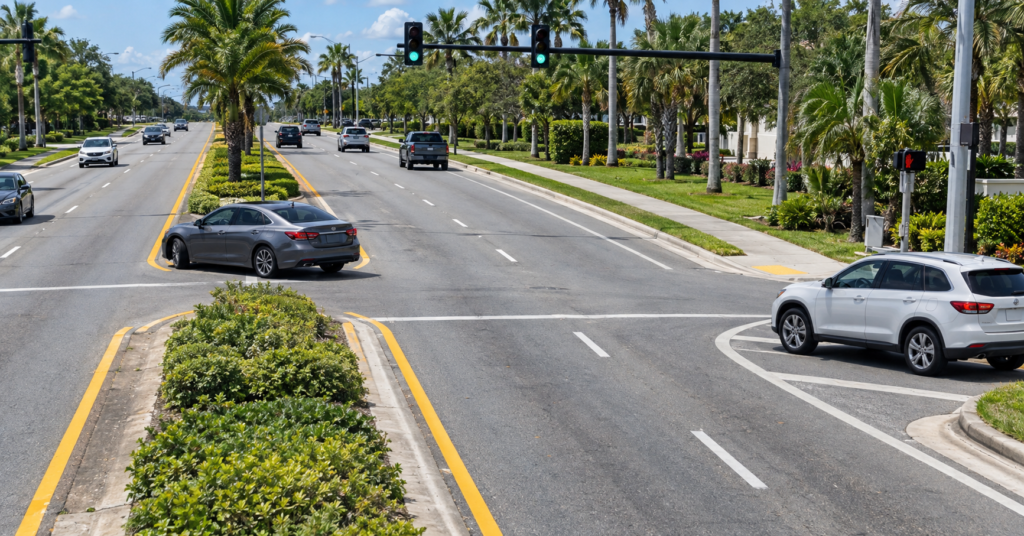
Florida U-Turn Rules require more than checking whether a “No U-Turn” sign is present. A driver must also determine whether the maneuver can be completed safely, whether it will interfere with traffic and what instructions apply at the intersection.
Confusion often develops when one driver is making a U-turn while another is turning right into the same roadway. Traffic signals, stop signs, lane markings and the movement of surrounding vehicles can all affect the situation. There is no single rule that gives every U-turning driver—or every right-turning driver—priority under all circumstances.
The Basic Florida U-Turn Rule
Section 316.1515 of the Florida Statutes states that a driver may not turn a vehicle to proceed in the opposite direction unless the movement can be completed safely, without interfering with other traffic and without violating a posted traffic-control sign.
This means a U-turn is not automatically lawful simply because no sign expressly prohibits it. The driver must have enough visibility, turning space and time to complete the movement without creating a conflict.
A U-turn may become unsafe when:
- Approaching vehicles are too close
- The driver cannot see far enough in either direction
- The vehicle cannot complete the turn within the available space
- Pedestrians or cyclists are crossing
- Traffic is entering from a side road or driveway
- The turn would require reversing or blocking multiple lanes
- A posted sign prohibits the maneuver
The legality of the turn depends on the complete situation, not only the presence of an opening in the median.
U-Turn Versus Right Turn on Red
One of the most confusing situations occurs when a driver with a green signal makes a U-turn while a driver on the cross street attempts to turn right on red.
The right-turning driver must first stop at the red signal and may proceed only after checking that the movement is permitted and yielding as required. A right turn on red is not an unrestricted right to enter the nearest lane.
The U-turning driver must still make the maneuver safely and avoid interfering with other traffic. A green light does not remove the driver’s responsibility to watch for vehicles, pedestrians and changing conditions.
Rather than relying on an assumption about who will yield, both drivers should confirm that the intended lane is clear. The right-turning driver should not pull into the roadway merely because the nearest lane appears open, and the U-turning driver should not assume another motorist has noticed the maneuver.
A Green Light Does Not Guarantee a Clear Path
A steady green signal permits traffic to proceed, but drivers must still obey signs, lane controls and yielding requirements. A vehicle already lawfully within the intersection, a pedestrian in a crosswalk or an unexpected obstruction may prevent the turn from being completed safely.
Before beginning a U-turn on green, check:
- Whether U-turns are prohibited
- Whether an oncoming vehicle is turning right
- Whether vehicles are approaching from a driveway
- Whether pedestrians have entered the crosswalk
- Whether the destination lane is open
- Whether the vehicle has enough turning radius
Do not enter the intersection and wait across active lanes if the turn cannot be completed. Blocking traffic can create a collision risk even when the initial signal was green.
Green Arrows and U-Turn Movements
A protected left-turn arrow controls left-turning traffic, but it should not automatically be interpreted as permission to make a U-turn. Drivers must look for signs that prohibit U-turns or limit the movement to a particular lane.
Some intersections use signs or signals designed specifically to manage conflicts between U-turns and right turns. A driver may see instructions such as “U-Turn Yield to Right Turn” or restrictions that operate during certain signal phases.
Follow the instruction posted at that particular intersection. General expectations should not override a traffic-control device.
U-Turn Versus Right Turn From a Stop Sign
A different rule applies when the right-turning vehicle is entering from a stop-controlled side road.
Under Section 316.123 of the Florida Statutes, a driver approaching a stop sign must stop at the marked line, before the crosswalk or at the nearest point with a view of approaching traffic. After stopping, the driver must yield to vehicles already in the intersection or approaching closely enough to present an immediate hazard.
A driver turning right from the stop sign should therefore wait when another vehicle is already completing a lawful movement through the intersection. At the same time, the U-turning driver remains responsible for ensuring the maneuver can be completed without interfering with traffic.
This shared responsibility is why defensive driving matters. Having a favorable traffic position does not justify continuing when another driver is clearly entering the same space.
U-Turns at Median Openings
Florida’s divided roads commonly include median openings where vehicles can turn left or reverse direction. These openings vary considerably in design.
Some provide a dedicated storage lane. Others use a wide paved area shared by traffic approaching from opposite directions. Restricted-crossing U-turn designs may direct drivers beyond the side street before turning back toward it.
At a standard median opening, drivers should enter only when there is enough room to leave through traffic completely. Part of the vehicle should not remain exposed in a travel lane while waiting for a gap.
Once positioned in the median, check traffic from the opposite direction before completing the U-turn. Vehicles traveling on the main road may be moving much faster than they appear.
Directional Crossovers and Florida U-Turn Rules
Some Florida roads use directional crossovers that prevent a direct left turn from a side street. Drivers instead turn right, enter a designated lane and make a U-turn at a downstream opening.
These designs are intended to reduce certain crossing conflicts, but they still require careful lane selection. A driver should follow pavement arrows and signs rather than moving across several lanes immediately after completing the U-turn.
Allow enough space to accelerate and merge gradually. If the desired driveway or side street is too close to reach safely, continue to another legal turning point instead of cutting across traffic.
Choosing the Correct Destination Lane
A U-turn may carry a vehicle across more than one lane, particularly when the road is wide or the vehicle has a large turning radius. Drivers should not assume they can always finish in the innermost lane.
The vehicle’s size, intersection design and pavement markings affect the path of travel. Pickup trucks, vans and vehicles towing trailers may need considerably more room than a compact car.
Before turning, identify the lane the vehicle will realistically enter. Check that entire path for right-turning traffic, motorcycles, cyclists and pedestrians. If completing the movement would require sweeping across occupied lanes, wait for a larger gap.
Left-Turn Lanes Are Not Always U-Turn Lanes
A lane marked for left turns does not necessarily permit every possible turning movement. Signs may prohibit U-turns even when left turns remain allowed.
Drivers should examine:
- Overhead lane-use signs
- Signs mounted beside the signal
- Pavement arrows
- Median signs
- Time-based restrictions
- Temporary construction controls
Construction can change a familiar intersection. A median opening that previously allowed U-turns may be closed or restricted, and temporary markings can direct drivers differently.
Visibility Can Make an Otherwise Permitted Turn Unsafe
Florida’s U-turn statute places safety at the center of the decision. Limited visibility may make the movement unsafe even when there is no prohibition sign.
Visibility may be reduced by:
- Curves or hills
- Heavy rain
- Sun glare
- Landscaping in the median
- Large vehicles in an adjacent lane
- Construction barriers
- Darkness or poor street lighting
- Vehicles waiting opposite the median
If another vehicle blocks the view, wait until it moves rather than edging into traffic. Drivers should be able to evaluate the full path before committing to the maneuver.
Pedestrians and Cyclists Add Another Conflict Point
Drivers often focus on other cars and overlook people crossing near the turning area. A U-turn can bring a vehicle through a crosswalk from an angle that a pedestrian or cyclist may not expect.
Check both sides of the intersection before moving. Someone may enter the crosswalk after the driver initially looks away.
Extra attention is necessary around schools, transit stops, shopping areas and beachfront streets. Pedestrian traffic can continue even when vehicle movement appears clear.
A driver should not accelerate through a U-turn to pass ahead of a pedestrian. Waiting for the crossing area to clear creates a more predictable movement for everyone.
Common U-Turn Mistakes
Several errors make U-turn conflicts more likely.
One is beginning the turn before confirming the destination lanes are clear. Another is using the size of a gap as the only test while ignoring the speed of approaching traffic.
Drivers may also misjudge their vehicle’s turning radius and need to stop, reverse or mount a curb. This creates an obstruction in an area where other drivers expect continuous movement.
Other common mistakes include turning from the wrong lane, ignoring a prohibition sign, failing to use a signal and attempting to make the maneuver across solid barriers or areas not designed for crossing.
When It Is Safer to Continue Driving
Missing a turn does not require making an immediate U-turn. Continuing to a controlled intersection, roundabout or designated crossover may add a few minutes but reduce risk.
Avoid forcing the maneuver when:
- Traffic is heavy or moving quickly
- The road has several wide lanes
- Visibility is limited
- The median is too narrow for the vehicle
- Another driver appears uncertain
- Pedestrians are nearby
- Road markings are unclear
- The vehicle is towing a trailer
- Weather makes judging distance difficult
A navigation system may instruct a driver to make a U-turn without knowing about temporary signs, construction or current traffic. Road conditions and legal signs take priority over navigation instructions.
What to Do After a U-Turn Collision
Move to a safe location when possible and call emergency services if anyone is injured or the crash creates an immediate hazard. Exchange identification and insurance information without arguing about fault at the roadside.
Document the scene before vehicles or temporary conditions change. Useful evidence may include:
- The position and damage to each vehicle
- Traffic signals and nearby signs
- Lane arrows and pavement markings
- The median’s design
- Skid marks or debris
- Weather and visibility
- Contact information for witnesses
- Dash-camera footage
Photograph the complete intersection rather than focusing only on vehicle damage. The signal arrangement, stop line and turning lanes may become important when the events are reviewed.
Do not rely on a simple statement that one vehicle was making a U-turn and the other was turning right. Fault can depend on signal phases, posted controls, vehicle positions and whether either driver made an unsafe movement.
A Safer Way to Approach Florida U-Turns
Treat every U-turn as a movement that requires a full view of the intersection and enough space to complete the turn without forcing another road user to brake or change direction.
Use the signal, slow before entering the turn and watch the destination lanes throughout the maneuver. If another driver appears ready to enter the same roadway, wait until their intention is clear.
Florida U-Turn Rules allow many of these maneuvers, but permission depends on safety, traffic interference and posted controls. Choosing a later turning point is usually preferable to testing an uncertain right-of-way situation.
Note: This article provides general information about Florida driving rules and is not legal advice. Traffic laws and intersection controls can change. Follow current signs and signals, consult the latest Florida Statutes and seek qualified legal guidance after a serious collision or citation.