Condo flood insurance should be reviewed before purchasing a unit in Miami, even when the association says the building is already insured. A master flood policy may protect the condominium building, but that does not automatically mean a buyer’s belongings, renovations or potential assessment exposure are fully covered.
The important question is not simply whether the building has flood insurance. Buyers need to understand which policy covers each part of the property, how much coverage exists and where responsibility shifts to the individual unit owner.
Why Miami Condo Flood Insurance Requires Extra Attention
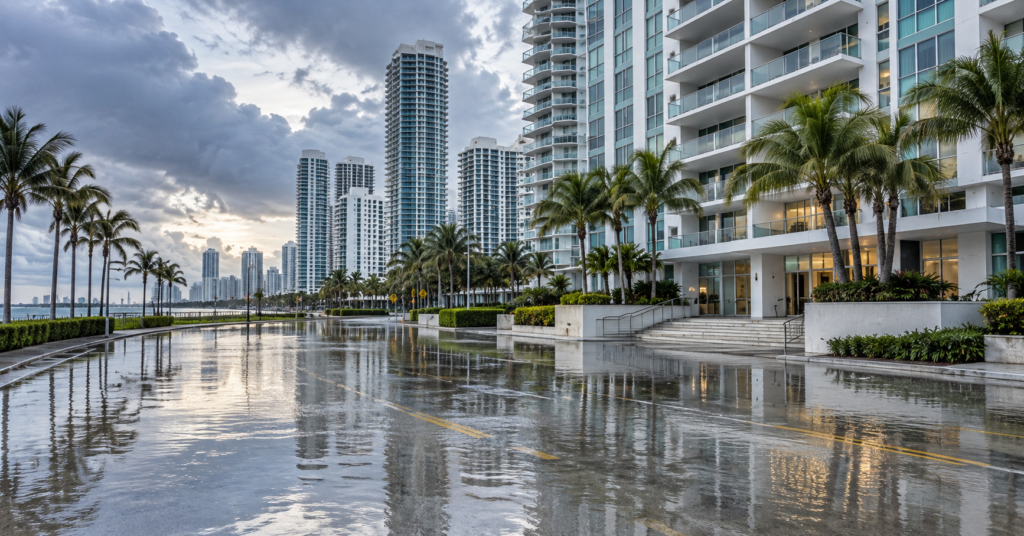
Miami’s exposure to heavy rain, storm surge, tidal flooding and drainage problems makes flood coverage an important part of condo due diligence. Risk can vary considerably between buildings based on location, elevation, construction, parking design and the placement of electrical or mechanical equipment.
Two buildings on the same street may not have the same exposure. One may have an elevated lobby and protected equipment, while another has parking, electrical systems or storage areas at a lower level.
A unit’s floor also does not tell the entire story. Someone purchasing on the tenth floor may have little concern about water entering the living room, but flooding can still damage elevators, electrical systems, entrance areas and other shared property. Repairs to those areas can affect access, association finances and future assessments.
The Master Flood Policy and the Unit Owner’s Policy
A condominium building may carry a Residential Condominium Building Association Policy, commonly called an RCBAP, through the National Flood Insurance Program. This policy is purchased in the association’s name and is designed to cover eligible flood damage to the insured residential condominium building.
The master policy can cover the structure, common elements and certain building components located within individual units. However, it does not insure a unit owner’s furniture, clothing, electronics and other personal belongings.
An individual unit owner may purchase separate flood coverage for personal property and eligible building items or improvements. The exact interaction between the individual policy and the master policy depends on the loss, ownership responsibilities, policy language and coverage limits.
FEMA provides a detailed summary of RCBAP coverage that buyers can use to understand the basic structure of an association policy.
Do Not Confuse Flood Coverage With the Association’s Property Policy
A condominium association may carry several different policies. Its general property or windstorm policy is not necessarily a flood policy.
Standard property insurance commonly excludes damage caused by flooding. A policy covering hurricane wind damage may therefore respond to a damaged roof or wind-driven debris while excluding rising water.
Ask for the declarations pages for the policies rather than accepting a general statement that the building has “full insurance.” Buyers should determine whether the documents describe:
- Flood coverage
- Windstorm coverage
- General property coverage
- Liability coverage
- Equipment breakdown coverage
- Excess flood coverage
Each policy addresses different risks. The presence of one should not be treated as proof that another exists.
Request the Master Flood Policy Declarations Page
The declarations page provides essential information about the association’s flood coverage. It should identify the insured building, policy period, coverage limit and deductible.
A buyer should request the current declarations page and confirm:
- The property address matches the condo being purchased
- The policy remains active
- The stated building limit
- The deductible
- The policy’s effective and expiration dates
- Whether the coverage is an NFIP policy or private flood policy
- Whether excess flood insurance exists
- Whether multiple buildings require separate coverage
A large condominium development may contain several separately insured buildings. A policy for another tower or parcel does not necessarily protect the buyer’s building.
The declarations page should be reviewed together with the full policy and any endorsements. It is not a complete explanation of every coverage condition or exclusion.
Compare Coverage With the Building’s Replacement Cost
A policy limit can appear substantial without being sufficient to rebuild the insured property. Buyers should ask the association for the most recent replacement-cost valuation and compare it with the master flood policy limit.
Under the NFIP’s RCBAP structure, a building insured below the applicable level may face a coinsurance penalty. FEMA’s summary of residential condominium coverage explains that building losses may be subject to a coinsurance penalty when coverage is below 80% of the building’s replacement cost.
A buyer does not need to calculate the association’s potential claim independently. Instead, the buyer can request written clarification from an insurance professional about whether the current limit satisfies applicable insurance-to-value requirements.
If the building’s valuation has not been updated despite rising construction costs, the policy may deserve closer examination.
Ask Whether Excess Flood Coverage Exists
NFIP policies have coverage limits. A large or high-value Miami condominium may have a replacement cost that exceeds the maximum available through the federal program.
An association may purchase excess flood coverage above its primary policy, but buyers should verify this rather than assume it has been done.
Questions to ask include:
- Does the association carry excess flood insurance?
- What limit does the excess policy provide?
- When does the excess coverage begin?
- Does it follow the same terms as the primary policy?
- Are there separate deductibles or exclusions?
- Has the excess policy been renewed for the current period?
A reference to excess insurance in meeting minutes or a budget is not a substitute for reviewing current proof of coverage.
Understand What Happens to Personal Belongings
The association’s master flood policy does not cover a unit owner’s personal possessions. Furniture, electronics, clothing and similar belongings generally require separate contents coverage.
FEMA’s flood coverage guidance for condo owners notes that building and contents coverage have separate limits and deductibles.
Buyers should create a realistic estimate of what it would cost to replace their possessions. Someone furnishing a primary residence may need a different amount than a buyer purchasing a lightly furnished seasonal unit.
Coverage terms may also limit payments for certain valuable property. Buyers with artwork, jewelry, collectibles or business equipment should not assume ordinary contents coverage will reimburse the entire value.
Review Renovations and Interior Improvements
Condo units are often renovated with upgraded flooring, cabinets, built-ins, bathroom finishes and other improvements. Responsibility for these items can be complicated because it may depend on the declaration of condominium, the association’s policy and the individual owner’s coverage.
A buyer should identify which interior components are:
- Part of the originally insured building
- Owned or maintained by the association
- Considered an owner-installed improvement
- Covered by the master flood policy
- Expected to be insured by the unit owner
This review is particularly important when a unit has undergone an expensive renovation. The purchase price may reflect luxury finishes that are not fully protected under the association’s limits.
Provide the governing documents, renovation details and master policy information to the insurance professional preparing the unit-level quote. A generic description of the condo may not reveal the full value of its improvements.
Examine the Master Policy Deductible
Even adequate policy limits do not eliminate out-of-pocket exposure. The master flood policy may have a substantial deductible that must be absorbed before insurance pays an eligible claim.
Buyers should determine:
- The amount of the deductible
- Whether different deductibles apply to separate buildings
- How the association expects to fund it
- Whether reserves are available for that purpose
- Whether governing documents allow the cost to be assessed to owners
Do not assume the deductible will be divided equally among all units. The condominium declaration and applicable decisions by the association may affect how expenses are allocated.
Investigate Potential Special Assessments
Flood damage can create expenses that exceed insurance proceeds or fall outside the available coverage. An association may then need to use reserves, borrow money or levy a special assessment.
An individual condo policy may provide some loss-assessment coverage, but it should not be treated as unlimited protection. Eligibility may depend on the cause of the loss, the reason for the assessment, policy language and whether the association maintained adequate insurance.
Ask an insurance professional to explain in writing:
- Whether the proposed unit policy covers flood-related assessments
- The applicable coverage limit
- The deductible
- Exclusions involving inadequate association insurance
- Whether a separate flood policy is required
- How the coverage interacts with the master policy
The phrase “loss-assessment coverage included” is not enough. Buyers need to understand when it applies and when it does not.
Check the Property’s Official Flood Zone
Miami-Dade County provides an official flood-zone map and property search that buyers can use to review a property’s mapped designation. FEMA’s Flood Map Service Center is the official source for federal flood-hazard mapping products.
The search should use the building’s exact address or parcel information. Buyers should save a copy of the result for their records and ask whether the property’s flood-zone designation has changed.
However, a mapped zone is only one part of the evaluation. It does not show every drainage issue, building vulnerability or future flooding possibility. FloodSmart explains that some flood risk exists everywhere, including locations outside designated high-risk zones.
Look Beyond the Unit’s Elevation
An upper-floor condo can still be affected by damage below it. Before buying, investigate the placement of important building systems, including:
- Electrical rooms
- Elevators and elevator controls
- Emergency generators
- Water pumps
- Fire-safety equipment
- Vehicle entrances
- Storage rooms
- Building access systems
If critical equipment is located at or below expected flood levels, the building could experience costly interruptions even if water never reaches the unit.
Ask whether flood-protection improvements have been completed, such as raised equipment, flood barriers, backflow protection or drainage upgrades. Request documentation rather than relying on a verbal description.
Review the Association’s Financial Records
Insurance should be considered alongside the condominium association’s financial condition. A building with limited reserves may have fewer options when facing a large deductible, uncovered damage or urgent repairs.
Review available budgets, reserve information, financial statements and recent board meeting minutes. Look for discussions involving:
- Flood insurance renewals
- Increasing deductibles
- Reduced coverage limits
- Drainage or waterproofing work
- Water intrusion
- Insurance claims
- Emergency borrowing
- Proposed assessments
- Disputes with insurers
A repeated decision to postpone drainage, waterproofing or equipment-relocation work may indicate an unresolved risk.
Request the Building’s Flood and Claim History
Ask the seller and association about prior flooding, water entry and insurance claims. The absence of a paid claim does not necessarily mean the property has never experienced a flood-related problem.
Questions should cover the garage, lobby, elevators, storage areas and mechanical rooms—not only the unit for sale.
Useful records may include repair invoices, engineering reports, remediation documents, insurance correspondence and meeting minutes. Buyers should distinguish rising-water flooding from leaks, wind-driven rain and plumbing failures because different policies may apply to each cause.
Florida’s resale disclosure language encourages condo buyers to discuss the need for separate flood insurance with an insurance professional. Buyers can review the relevant requirements in Section 718.503 of the Florida Statutes.
Obtain Insurance Quotes Before the Contract Deadline
Waiting until closing to investigate condo flood insurance can create financing and budgeting problems. Buyers should seek quotes while they still have time to evaluate the property and available coverage.
Provide the insurance professional with:
- The unit address and floor
- The association’s declarations pages
- The building’s replacement-cost information
- The flood-zone determination
- Details of interior renovations
- The estimated value of personal belongings
- The association’s deductible
- Any excess flood policy
- Available claim information
Ask for an explanation of what is covered by the master policy, what requires individual coverage and what would remain uninsured.
If the purchase involves a mortgage, confirm the lender’s flood-insurance requirements early. A lender may request association documents or impose conditions that affect the closing timeline.
Documents Miami Condo Buyers Should Request
Before completing the insurance review, a buyer should try to obtain:
- The current master flood policy
- The policy declarations page
- Any excess flood policy
- The association’s property and windstorm policies
- The latest building replacement-cost valuation
- The condominium declaration and insurance provisions
- Current budget and reserve information
- Recent board meeting minutes
- Notices of pending assessments
- Available flood-loss and claim records
- The unit’s existing insurance information, when available
- A unit-level flood insurance quote
These documents should be reviewed as a connected set. A high policy limit can still be weakened by a large deductible, insufficient valuation, restrictive terms or inadequate association funds.
Make the Insurance Review Part of the Buying Decision
Condo flood insurance gaps do not automatically make a Miami property unsuitable. They do, however, affect the true cost and risk of ownership.
A buyer may decide that the building has appropriate coverage, strong reserves and manageable deductibles. Another building may require additional unit coverage or present a level of assessment exposure the buyer is unwilling to accept.
The goal is to identify those differences before closing. Confirming the master policy, individual responsibilities and association finances provides a much clearer picture than relying on a listing that simply states flood insurance is included in the monthly fee.
Note: Flood insurance coverage depends on the specific policies, condominium documents, property and lender requirements. Buyers should obtain current records and consult qualified insurance, legal and real-estate professionals before purchasing a Miami condominium.