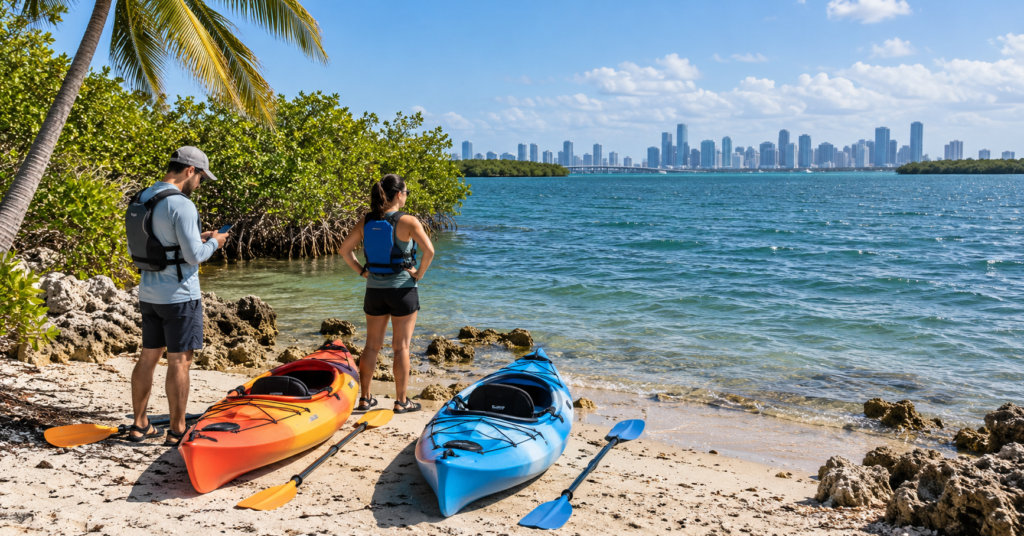
Miami kayaking can feel easy when a breeze pushes you away from the launch. The difficulty may become apparent only when you turn around and discover how much effort it takes to paddle back. A pleasant outward journey is therefore a poor measure of how manageable the complete trip will be.
Before launching on Biscayne Bay, consider the wind expected during your return, the exposure along your route, and the abilities of everyone in the group. Choose a trip you can shorten comfortably rather than one that depends on conditions staying exactly as they were at departure.
Read a marine forecast for the actual route
A general Miami weather forecast may show sunshine while leaving important paddling details unclear. Use a marine forecast covering the water you intend to explore, then check the periods that include both departure and return.
The National Weather Service’s Biscayne Bay marine forecast provides wind and weather information for the selected location. Check the map as well as the forecast text so you understand which area it describes.
Read wind direction, sustained speed, gusts, and any thunderstorms or marine warnings. Note whether conditions are expected to strengthen or change while you are out. A forecast is planning information, so compare it with what you observe at the launch.
Translate wind direction into your return journey
Wind directions describe where the wind comes from. An easterly wind comes from the east and generally pushes toward the west. Relate that direction to your route on a map before deciding which way to paddle.
Mark the launch, intended destination, and return path. Ask where the wind would be ahead of you, behind you, or across the kayak. A breeze that helps on the outward leg may oppose you on the way home.
Crosswinds deserve attention too. They can push the kayak sideways and require repeated correction. A route may feel tiring even when the wind is not blowing directly against your direction of travel.
Inspect the water beyond the sheltered launch
A quiet launch does not establish that the whole route is calm. Buildings, trees, and shoreline shape can shelter the departure area while more exposed water nearby has different conditions.
Look beyond the immediate shoreline. Watch for rougher patches, breaking wave tops, and other signs that the water outside the sheltered area differs from what you first noticed. If you cannot assess the next section confidently, choose a more protected outing or postpone.
Biscayne National Park’s canoeing and kayaking guidance specifically advises paddlers to check weather and prepare for wind, rain, and unexpected changes.
Choose a route with manageable exit options
Plot the entire journey rather than drawing a straight line to an attractive destination. Identify exposed stretches, navigation channels, shallow areas, and places where you could legally leave the water if needed.
A shoreline that looks close on a map may be lined with private property, dense mangroves, or structures that prevent landing. Do not assume every visible edge of land is an available exit.
For an unfamiliar route, seek current advice from park staff or a knowledgeable paddling professional. Explain your experience, kayak type, intended route, and group size. General reassurance that “people paddle there” does not answer whether the trip suits your circumstances.
Avoid using easy outward progress as your distance limit
A following wind can make you travel farther than expected without much apparent effort. Resist extending the route simply because the first section feels comfortable.
Set a modest destination and a clear turnaround point before departure. Leave room to turn earlier if progress, weather, or group comfort differs from the plan. There is no single wind-speed threshold that makes every kayak, route, and paddler safe.
If conditions already require hard work to maintain control near the launch, that is useful information before you commit to a longer journey. You do not need to reach the planned destination to have a worthwhile outing.
Account for tides and currents separately
Wind is only one influence on the return trip. Check tide predictions and obtain local information about currents, particularly around channels and constricted areas.
The National Park Service notes that Biscayne’s shallow waters make tide predictions important for boating. Its tide information is a starting point for understanding water-level changes.
Do not assume that knowing the time of high tide tells you the current direction everywhere. Likewise, water that was deep enough on departure may be shallower later. Choose a route that remains suitable through the expected conditions and avoids damaging sensitive shallow habitats.
Plan around the least confident paddler
Discuss experience before choosing the route. Ask whether everyone can steer, maintain a steady pace, and manage the conditions expected outside the launch area.
Keep the group together and make turning back a shared decision. One person’s comfortable pace may exhaust someone else, especially after time in the sun. Check how everyone feels before moving into a more exposed section.
Wear a properly fitted life jacket and carry suitable communication and safety equipment for the outing. Keep essential communication accessible and protected from water rather than buried in luggage that would be difficult to reach.
Build the return time around shore access
Check when the launch, parking area, gates, and any booked equipment must be clear. Sunset may be later than the facility’s closing time.
For example, Biscayne National Park currently lists Convoy Point’s canoe and kayak launch as open from 7 a.m. to 5:30 p.m. Check the park’s operating hours and current alerts before relying on that schedule.
Allow time after landing to unload, carry equipment, and leave the site. Your target should be a comfortable return with time in reserve, rather than arriving at the water’s edge just as access closes.
Reassess during the outing
Pause at useful landmarks to check the wind, water, sky, and group’s energy. Increasing effort, worsening control, darkening weather, or a slower paddler are reasons to shorten the trip early.
Leave a float plan with someone ashore identifying your route, companions, and expected return. The National Park Service recommends this as part of safe paddling preparation. Tell that person when you return or if the plan changes.
Miami kayaking is more enjoyable when the return is planned with the same care as the destination. Assess the whole route, leave time and energy in reserve, and be willing to choose a shorter day on the water.
Note: Marine conditions can change quickly. Review current forecasts, warnings, access information, and local advice before launching, and choose conditions appropriate to your skills and equipment.